

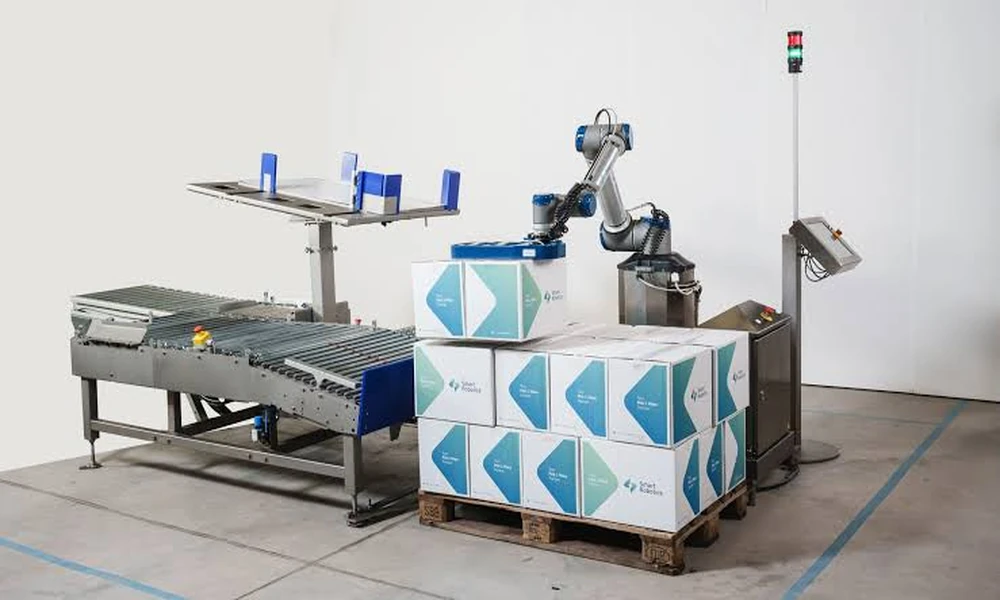
Anyone who has walked a production floor at the end of a shift knows the scene: pallets stacked unevenly, boxes shifting during transport, and a handful of workers nursing sore backs after hours of repetitive lifting. It’s not dramatic, but it’s costly. Palletizing has always been one of those tasks that looks simple on paper and turns into a bottleneck in practice. Automating it changes the math for an entire facility, not just the end of the line.
Why Palletizing Became a Bottleneck in the First Place
Manual palletizing is deceptively demanding. Workers must lift, rotate, and stack boxes of varying weights and dimensions, often thousands of times per shift. The physical strain leads to musculoskeletal injuries, which in turn drives up absenteeism and workers’ compensation claims. Beyond the human cost, manual stacking is inconsistent. Two operators rarely build a pallet the same way, and that variability creates downstream problems: unstable loads, wasted shrink wrap, and pallets that get rejected by logistics partners because they don’t meet stacking specifications.
This inconsistency is the real efficiency killer. A production line can run at full speed, but if the palletizing station can’t keep pace or produces unreliable output, the entire throughput of the warehouse suffers. That’s the gap automation was built to close.
What Automated Palletizing Actually Solves
At its core, an automated palletizing cell replaces the manual lifting and stacking sequence with a robotic arm equipped with an end-of-arm tool, guided by a defined stacking pattern. The payload capacity of the robot determines how heavy a box it can safely handle, and this figure directly dictates which product lines can be automated first. A system rated for 20 kilograms, for example, will comfortably manage most retail cartons but may need reinforcement for bagged goods or liquid containers.
Just as important is the cycle time – the number of seconds it takes to pick, move, and place a single item. A shorter cycle time means more pallets built per hour, which has a direct effect on how quickly finished goods clear the production area and move into storage or shipping. When cycle time drops even slightly, the ripple effect reaches conveyor scheduling, forklift traffic, and dock door availability.
The Rise of Collaborative Systems on the Floor
One of the most significant shifts in this space has been the adoption of a collaborative robot palletizer, a system designed to work safely alongside human staff without the extensive fencing and safety cages that traditional industrial robots require. This matters enormously for facilities with limited floor space or those running mixed manual-automated lines, since it removes the need for a costly, dedicated safety perimeter. You can read more about how these systems are configured for different production environments through this collaborative robot palletizer overview.
Because these systems are built around force-limiting sensors, they can detect unexpected contact and stop instantly, which is what allows them to operate near people in the first place. The practical consequence is flexibility: a plant manager can redeploy the same cell to a different product line or shift it closer to a packaging station without re-engineering the entire safety infrastructure.
Measuring the Efficiency Gain
The efficiency argument for automated palletizing rests on three concrete pillars.
Throughput consistency. Robots don’t get tired, distracted, or slower toward the end of a shift. A cell running at a fixed cycle time produces predictable output hour after hour, which makes production forecasting far more reliable.
Load quality. Automated systems follow a programmed stacking pattern with sub-millimeter placement accuracy, meaning every pallet is built to the same specification. This reduces load shifting during transport, which lowers damage claims and the frequency of product returns.
Labor reallocation. Removing repetitive lifting from the equation doesn’t eliminate jobs so much as it reassigns them. Workers previously tied to physically taxing palletizing stations can move into quality control, machine tending, or line supervision – roles that require judgment rather than repetitive motion.
Integration Considerations for Automation Engineers
None of this happens by simply bolting a robot onto the end of a line. Successful integration depends on aligning the robot’s reach envelope with the actual pallet footprint and box dimensions used on-site. Undersized reach forces awkward positioning that slows the cycle; oversized reach wastes floor space that could otherwise house buffer conveyors.
Vision systems also play a growing role. A camera-guided pick station allows the robot to adjust for slight variations in box position or orientation coming off the line, which prevents the kind of misalignment that would otherwise stop production for manual correction. For facilities running several SKUs on the same line, this adaptability is often the difference between a system that works in a demo and one that holds up during a real production week.
The Bottom Line for Plant Operations
Automated palletizing isn’t a single upgrade – it’s a structural change to how a warehouse handles the final, most physically demanding step before goods leave the building. The gains compound: fewer injuries mean fewer disruptions, tighter cycle times mean better throughput forecasting, and consistent load quality means fewer disputes with carriers and customers. For manufacturing engineers and plant managers evaluating where to invest next, the palletizing station remains one of the clearest cases where automation pays for itself through operational stability as much as raw speed.
